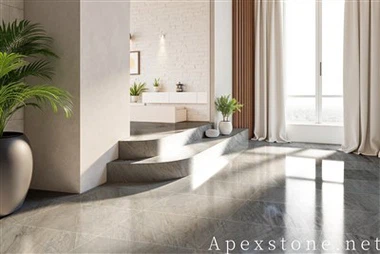
600 x 600 octagon black Marble wall
Sep 05, 2025
Production Process: From Block to Finished Product

1. Quarrying & Block Selection
Process: Extract large marble blocks from quarries (e.g., sources of "Givenchy Black"). Select blocks with uniform dark color, minimal veining/fractures, and structural integrity.
Machinery: Diamond wire saws, chain saws, drilling rigs.
Key Focus: Ensure blocks are free of major cracks or color variations that would compromise the final product's consistency.
2. Primary Sawing (Block to Slabs)
Process: Slice the selected block into thick slabs (e.g., 2–3 cm thick) using horizontal cuts. Thickness depends on the final tile's desired depth (e.g., 12mm for wall tiles).
Machinery: Gang Saw (most efficient for large-volume slabbing). Uses multiple diamond-tipped blades to slice blocks into parallel slabs.
Key Focus: Achieve parallel cuts for uniform slab thickness and minimize surface damage.
3. Calibration (Thicknessing)
Process: Grind the slab surfaces to achieve precise, uniform thickness (e.g., 12mm ±0.1mm) across all slabs. Critical for seamless installation and load-bearing capacity.
Machinery: Automatic Calibrating Machine with 4–8 diamond grinding heads. Water-cooling prevents overheating.
Key Focus: Eliminate warping, ensure flatness, and maintain strict thickness tolerances.
4. Surface Finishing (Polishing/Honing)
Process: Refine the slab surface to the desired finish. For a public restroom, balance luxury (Givenchy Black's iconic sheen) with functionality (slip resistance):
High-Polish: For a luxurious look (common for Givenchy Black). Involves progressive grit abrasives (up to 3000#) and polishing compounds.
Honed/Matte: For enhanced slip resistance (recommended for wet areas). Stops at medium grits (e.g., #400–#800).
Machinery: Multi-Head Automatic Polishing Line with 10–15 rotating heads. Adjust grit sequences based on the desired finish.
Key Focus: Achieve a flawless, uniform finish (no swirls, dull spots). For polished tiles, ensure a deep, reflective gloss; for honed, maintain consistent texture.

5. Cutting to Octagon Shape
Process: Precisely cut calibrated slabs into 600x600mm octagons. The octagon must have 8 equal sides and 135° internal angles for geometric consistency.
Machinery: CNC Bridge Saw with Octagon Toolpath Software (most precise). Computer-controlled blade follows a pre-programmed path to cut the octagon shape.
Alternative: Waterjet Cutter (used for complex shapes, but slower for regular octagons).
Key Focus: Ensure dimensional accuracy (±0.3mm tolerance) and perfect angular alignment. Any deviation will disrupt the wall's pattern.
6. Edge Profiling
Process: Shape the octagon's edges for safety and aesthetics. Common profiles include:
Chamfered Edge: Slightly angled to reduce chipping.
Rounded Edge: Softened corners for a sleek look.
Machinery: CNC Edge Profiler with diamond-shaped wheels. Automates consistent edge finishes across all pieces.
Key Focus: Ensure edges are smooth, uniform, and match the surface finish (e.g., polished edges for cohesion).
7. Quality Control & Inspection
Process: Rigorous checks at every stage:
Octagon Geometry: Verify side lengths (600mm ±0.3mm) and angles (135° ±0.5°) using digital calipers and angle gauges.
Surface Finish: Use gloss meters to confirm uniform reflectivity (e.g., 85–95 GU for polish) or texture for honed tiles.
Color/Texture: Match all pieces to reference samples to ensure consistency.
Defects: Reject pieces with cracks, chips, stains, or uneven finishes.
Machinery: Digital calipers, angle gauges, gloss meters, light tables (for internal flaw inspection).
8. Packing & Shipping
Process: Clean, label (size, finish, batch), and pack pieces securely to prevent damage.
Machinery: Vacuum Lifters (safe handling of individual tiles), custom crates with foam/rubber padding, strapping machines.
Key Focus: Prevent chipping, scratching, or breakage during transit. Clearly mark batches for traceability.
Critical Factors for Achieving High-Quality Octagon Tiles
Geometric Precision
Equal Sides & Angles: The octagon must have 8 identical sides and 135° angles. Any deviation will create gaps or misalignment in the wall, ruining the aesthetic. CNC cutting is non-negotiable for this.
Surface Finish Consistency
For Givenchy Black, a deep, reflective polish is iconic. Swirl marks, dull spots, or inconsistent gloss will diminish the luxury appeal. Strict adherence to the polishing sequence and machine maintenance is essential.
Durability for Restroom Conditions
Public restrooms expose tiles to moisture, chemicals, and frequent cleaning. Key measures:
Penetrating Sealer: Applied post-finishing to repel stains and enhance durability.
Finish Choice: Honed/matte finishes offer better slip resistance for wet areas, while polished finishes require regular re-sealing to maintain performance.
Edge Quality
Octagon edges are prone to chipping during cutting or handling. Chamfered or rounded edges reduce this risk and improve safety (no sharp corners).
Color Uniformity
Givenchy Black relies on its rich, consistent color. Variations in veining or tone will make the wall look patchy. Strict block selection and sorting during production are critical.
Handling & Protection
Despite being smaller than large-format tiles, 600x600mm octagons are heavy and brittle. Use vacuum lifters and padded crates to avoid breakage during processing and shipping.
Compliance with Standards
Ensure tiles meet industry standards for:
Slip Resistance: ASTM C1028 or EN 14231 (critical for restroom safety).
Water Absorption: Low porosity (typical for marble) to resist mold and mildew.
Chemical Resistance: Ability to withstand cleaning agents (e.g., bleach, acids).