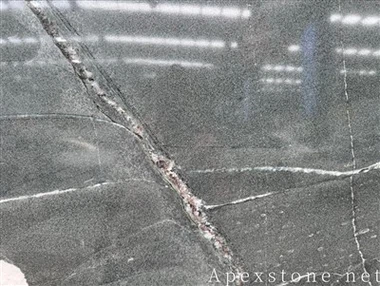
6x24 ledger stone black Marble floor entrance
Sep 05, 2025
Production Process: From Block to Finished Product

1. Quarrying & Block Selection
Process: Extract large marble blocks from quarries (e.g., sources of "Givenchy Black" or similar premium black marble). Select blocks with uniform dark color, minimal veining/fractures, and structural integrity.
Machinery: Diamond wire saws, chain saws, drilling rigs, loaders.
Key Focus: Ensure blocks are free of major cracks or color variations that would compromise the final product's consistency.
2. Primary Sawing (Block to Slabs)
Process: Slice the selected block into thick slabs (e.g., 3–4 cm thick) using horizontal or vertical cuts. Thickness depends on the final ledger stone's desired depth (e.g., 1.25"/3cm for durability).
Machinery:
Gang Saw: Most efficient for large-volume slabbing. Uses multiple diamond-tipped blades to slice blocks into parallel slabs.
Diamond Wire Saw: Alternative for irregular blocks or complex cuts (slower but more flexible).
Key Focus: Achieve parallel cuts for uniform slab thickness and minimize surface damage.
3. Calibration (Thicknessing)
Process: Grind the slab surfaces to achieve precise, uniform thickness (e.g., 12mm ±0.1mm) across all slabs. Critical for seamless installation and load-bearing capacity.
Machinery: Automatic Calibrating Machine with 4–8 diamond grinding heads. Water-cooling prevents overheating.
Key Focus: Eliminate warping, ensure flatness, and maintain strict thickness tolerances.
4. Surface Finishing (Polishing/Honing)
Process: Refine the slab surface to the desired finish (e.g., high-polish for Givenchy Black's luxurious sheen or honed for a matte look). Involves progressive grit abrasives.
Machinery: Multi-Head Automatic Polishing Line with 10–15 rotating heads:
Coarse grits (60–400#) remove saw marks and deep scratches.
Fine grits (800–3000#) refine the surface.
Polishing heads (felt pads + polishing compound) create the final gloss.
Key Focus: Achieve a flawless, uniform finish (no swirls, dull spots, or orange-peel texture). For Givenchy Black, a deep, reflective gloss is essential to highlight its rich color.

5. Cutting to Size (6x24 Inches)
Process: Precisely cut calibrated slabs into 6" x 24" pieces. Squareness and dimensional accuracy are non-negotiable for tight installation gaps.
Machinery: CNC Bridge Saw (most efficient for straight cuts). Computer-controlled blade ensures exact dimensions (±0.3mm tolerance) and 90° angles.
Alternative: Waterjet cutter (used for complex shapes or delicate materials, but slower for standard rectangles).
6. Edge Profiling (Optional)
Process: Shape edges (e.g., eased, beveled, or pencil-round) for safety and aesthetics. Common for ledger stones to reduce chipping and enhance visual appeal.
Machinery: CNC Edge Profiler with diamond-shaped wheels. Automates consistent edge finishes across all pieces.
Key Focus: Ensure edges are smooth, uniform, and match the surface finish (e.g., polished edges for a cohesive look).
7. Quality Control & Inspection
Process: Rigorous checks at every stage:
Color/Texture Consistency: Match all pieces to reference samples.
Surface Finish: Use gloss meters to verify uniform reflectivity (e.g., 85–95 GU for high-polish).
Dimensions: Verify 6"x24" size and squareness with calipers and straightedges.
Defects: Reject pieces with cracks, chips, stains, or uneven finishes.
Machinery: Calipers, gloss meters, light tables (to inspect internal flaws), digital measuring systems.
8. Packing & Shipping
Process: Clean, label (size, finish, batch), and pack pieces securely to prevent damage.
Machinery: Vacuum Lifters (safe handling of individual pieces), custom crates with foam/rubber padding, strapping machines.
Key Focus: Prevent chipping, scratching, or breakage during transit. Clearly mark batches for traceability.
Critical Factors for Achieving High-Quality Ledger Stones
Material Consistency
Start with premium blocks free of color variation, cracks, or mineral veins. Inconsistent material ruins the cohesive look of a stacked or tiled installation.
Dimensional Precision
Exact 6x24 dimensions and perfect square edges are non-negotiable. Even minor deviations cause lippage (uneven edges) or gaps in the final installation.
Uniform Surface Finish
For Givenchy Black, a deep, reflective polish is iconic. Swirl marks, dull spots, or inconsistent gloss ruin the luxury aesthetic. Regular maintenance of polishing heads and strict grit sequences are essential.
Handling & Protection
Despite smaller size, marble is brittle. Use vacuum lifters and trained operators to avoid chipping during cutting, polishing, or packing. Resin treatment (if applied) enhances durability and reduces staining.
Resin Treatment (Recommended)
Black marble often has porous micro-fractures. Impregnating resin fills these voids, preventing stains and improving structural integrity. Ensure the resin is UV-stable and non-yellowing to preserve the black color.
Quality Control at Every Stage
Inspect blocks, slabs, and finished pieces. Traceability (labeling batches) allows quick identification of issues. Reject defective pieces immediately to maintain brand reputation.
Installation Compatibility
While not part of factory production, ensure the ledger stones are compatible with the intended installation system (e.g., adhesive, mechanical anchors). Provide clear guidelines for installers to preserve quality.