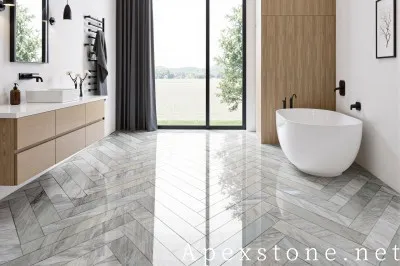
blue Marble Curved tile bathroom wall
Aug 23, 2025
Overall Design Philosophy: Curved Opulence

The goal is to create a cinematic, immersive experience reminiscent of a 1920s luxury hotel or ocean liner. Every element should feel intentional, crafted, and part of a cohesive whole. The curved Palissandro Azzurro tiles are not just a wall covering; they are the architectural soul of the room. The design will play with geometric forms (curves against strong verticals and horizontals), high-contrast finishes, and a lavish yet streamlined material palette.
1. The Walls: Palissandro Azzurro Curved Tiles
This is your primary feature and the source of the room's character.
Application: Install these tiles in a strategic, impactful way. The most dramatic approach is to create a full-height curved niche or alcove for the bathtub, making it the stunning focal point of the room. Alternatively, use them to clad a single feature wall behind the vanity or to create rounded, column-like structures on either side of the mirror.
Layout and Grout: For a seamless, monolithic look that emphasizes the stone's veining rather than the grid pattern, use a thin-set installation with the narrowest possible grout lines. The grout color should be a perfect match to the whitest part of the marble (e.g., a bright white epoxy grout), making the tiles appear as a single, carved marble wall.
Role: The curved tiles provide softness, movement, and undeniable luxury. Their cool blue-grey veins set the entire color story for the space.
2. The Floor: Geometric Contrast
The floor must complement the walls without competing with them. It should provide a geometric counterpoint to the curves.
Material and Pattern: Continue the Palissandro Azzurro marble, but in a different format and finish. Use large-format (24"x24"), honed marble tiles laid in a simple grid pattern. This provides continuity of material but contrast in form and texture.
Alternative for Budget/Durability: A superb Art Deco alternative is a black and white geometric floor. Imagine high-gloss black hexagonal (hex) tiles with small white diamond inserts, or a custom chevron (zigzag) pattern in black and white marble. This is a quintessential Deco motif that creates a powerful, graphic foundation that makes the blue veins in the wall pop.
Finish: A honed finish on the floor is practical (slip-resistant) and offers a velvety textural contrast to the likely polished curves and any glossy black elements.
3. The Vanity: A Statement of Craftsmanship
The vanity is a key piece of furniture in an Art Deco bathroom.
Style: Design a vanity that reflects Deco craftsmanship. Think of a high-gloss, lacquered base in a deep, rich color like navy blue, emerald green, or even a bold black. The silhouette should be sleek and vertical, perhaps with subtly fluted or reeded details on the doors-a classic Deco textural element.
Hardware: Hardware is jewelry. Choose polished chrome or brass with geometric shapes. Look for pulls with stepped designs, sunburst patterns, or simple, elegant vertical bars.
Mirror: Above the vanity, opt for a large, round or oval mirror with a bold, geometric frame. A frame in polished chrome with a stepped design is perfect. Alternatively, a mirror with integrated, minimalist LED lighting around the perimeter offers a modern take on Deco glamour.
4. The Vanity Top & Sink: Sculptural Integration
This is where the marble takes center stage again.
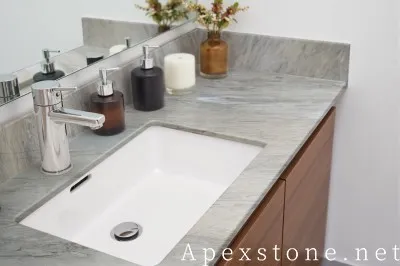
Material and Finish: Fabricate the vanity top from the Palissandro Azzurro marble, ensuring the veining is thoughtfully laid out to create a sense of flow. The finish should be highly polished to maximize the stone's depth and luminosity, creating a reflective surface that amplifies the light.
Sink Type: To maintain the sleek, architectural lines of the vanity, choose an integrated sink basin. This is where the countertop marble is carved and polished to form the bowl itself, creating a seamless, sculptural, and incredibly luxurious look. It eliminates visual breaks and emphasizes the beauty of the stone.
Faucet: The faucet should be a sculptural statement piece. A wall-mounted faucet in polished chrome with a graceful, arched spout would be exquisite, complementing the curved tiles beautifully. Alternatively, a deck-mounted mixer with a tall, geometric lever handle would also be perfectly in theme.
5. The Lighting: Layered Drama
Lighting is crucial for enhancing the textures and curves of the space.
Ambient Lighting: Avoid a single, harsh central light. Instead, use concealed LED cove lighting around the ceiling perimeter or above the curved tub alcove to wash the walls with a soft, indirect glow. This will highlight the curves of the tiles and create a serene atmosphere.
Task Lighting: Flank the vanity mirror with a pair of elegant sconces. The ideal choice would be fixtures with cylindrical or globular glass shades in frosted glass, mounted on polished chrome bases. This provides perfect, shadow-free light for grooming and adds symmetrical, vertical elements that are pure Art Deco.
Accent Lighting: Install a small, discreet pin spotlight to graze the feature wall, dramatically highlighting the texture of the curved tiles and the intricate veining of the stone. Consider LED strips underneath the floating vanity or behind the mirror for a modern, ambient glow.