

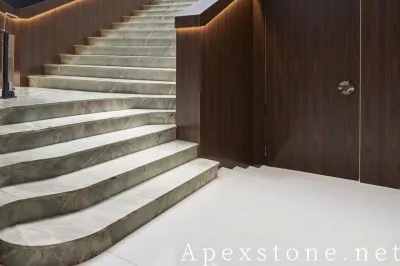
Matt pattern green Marble wall foyer
Sep 11, 2025
Main Quality Issues for Matt Finish Marble (Hotel Foyer)
For a matt finish wall, the concerns shift from translucency (as with backlit stone) to surface integrity, consistency, and color.
1. Surface Imperfections and Damage: This is the #1 issue.
• Scratches and Grinding Marks: The honing process must be even. Poor handling can cause deep scratches that are glaringly obvious on a flat, non-reflective surface.
• Chips and Pitting: The edges and the face of the stone are vulnerable to chipping. The soft nature of marble means it can also have natural pits or voids that may have been poorly filled.
• Etching: Even pre-installation, contact with acidic substances can dull the surface, leaving light spots that are immediately visible on a matt finish.
2. Fissures vs. Cracks:
• Natural Fissures: These are common, healed geological formations. On a matt surface, they are less noticeable than when backlit, but large or numerous fissures can be considered a defect if they compromise structural integrity or aesthetics.
• Cracks: Any new, unhealed crack is a reason for rejection. It indicates structural weakness and will be a visible flaw.
3. Color and Veining Consistency:
• Batch Variation: Marble is a natural product. The shade of green and the density of white veining can vary significantly from one block to the next. For a hotel foyer, you need a consistent look.
• Blotchiness: Within a single slab, the color must be consistent. Uneven mineral distribution can create dull, blotchy patches that look like defects once installed.

4. Poor Resin Filling (Honed Finish Specific):
• Many marbles are resin-coated at the factory to fill natural pits and fissures before being honed to a matt finish.
• The Problem: If the resin is not a perfect color match, it will be visible as shiny spots or patches with a different texture on the otherwise uniform matt surface. Low-quality resin can yellow over time.
5. Thickness and Calibration:
• While less critical than for backlit stone, inconsistent slab thickness makes installation incredibly difficult. It can lead to lippage (tiles not being flush) and an uneven wall plane, which is highly undesirable in a luxury setting.

The Inspector's Toolkit: What to Bring to the Slab Yard
Come prepared. Your goal is to simulate how the stone will look in a well-lit foyer.
1. High-Power LED Flashlight (Two Types):
• A Raking Light Source: This is your most important tool. Use a flashlight or your phone's light and hold it at a very low (5-15 degree) angle to the stone's surface. This grazing light will reveal:
• Scratches and grinding marks (they will cast shadows).
• Lippage and surface unevenness.
• Texture inconsistencies between the stone and any resin fills.
•A Standard Beam: To inspect for internal cracks and fissures by shining it through the stone (though less critical than for backlit).
2. Tape Measure and Digital Caliper:
• Tape Measure: For overall dimensions.
• Digital Caliper: To check thickness consistency across the slab (e.g., all four corners and the center). Reject slabs with significant variance.

3. A Bottle of Water and a Rag (The "Wet Test"):
•This is non-negotiable for matt stone. Water temporarily darkens the marble, simulating what it will look like with a protective sealer applied and gives you the truest sense of its final installed color.
• How to use: Spray or pour a small amount of water on an inconspicuous area. This reveals:
• The true, final color.
• Hides superficial scratches (if they disappear when wet, they are light and can likely be honed out; if they remain, they are deep).
• Makes any color blotchiness or resin fills much more obvious.
4. Polarized Sunglasses:
• Helps cut the glare in a bright warehouse, allowing you to see the true color and surface texture without reflection.
5. Smartphone Camera:
• Take detailed photos and videos of each slab under both raking light and when wet. This documents condition and is invaluable for matching slabs later.
6. Marker or Grease Pencil:
• To mark any flaws directly on the stone (usually on the edge or back) and to number the slabs for your installation map.

Inspection Checklist at the Yard:
1. Review Dry with Raking Light: Scan the entire surface of each slab with light held at a shallow angle. Circle every scratch, chip, and pit you find.
2. Perform the Wet Test: Apply water to a representative section. Does the color become rich and uniform? Are the flaws still visible? This is the true preview.
3. Check the Edges: Look for chipping or damage on all sides.
4. Check the Back: Ensure the slab is properly mesh-backed if required for stability.
5. Lay Slabs Side-by-Side: Ensure the color and veining flow consistently from one slab to the next. You are creating a mural, not just a wall.
6. Verify Quantity: Order a minimum of 20% overage to allow for cutting, waste, and future repairs. For a high-profile project like this, 25-30% is not unreasonable.
Final Professional Advice: Work with a reputable stone supplier and bring your project's designer or a experienced stone installer with you to the inspection. Their trained eye is your best insurance policy. Never approve a bundle without inspecting every single slab.


