

3x6 board blue Marble wall office
Aug 23, 2025
Overall Design Philosophy: Tranquil Authority
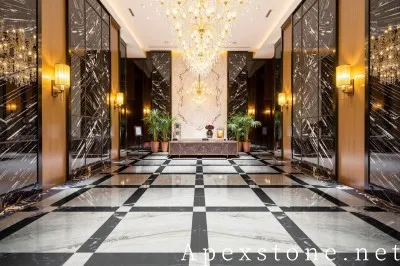
The goal is to create a space that immediately instills a sense of calm confidence in visitors and employees. The lobby should be a transitional sanctuary from the outside world, reducing stress and elevating the brand experience. The Palissandro Azzurro tile wall is the focal artwork; every other element will be chosen to frame it, complement its natural beauty, and create a harmonious, uncluttered environment. The palette is strictly derived from the stone itself: whites, greys, blues, and warm wood tones.
1. The Focal Wall: Palissandro Azzurro 3x6 Board Tiles
This is the defining feature of the lobby, setting the tone for the entire space.
Application: Install the tiles on the primary feature wall behind the reception desk. This immediate, bold statement conveys success and attention to detail. The vertical "board" orientation of the 3x6 tiles will subtly emphasize the height of the space, making it feel grand and airy.
Layout and Grout: For a sleek, continuous look, use a thin-set method with a minimal grout joint. The grout color should be a light grey that matches the veins in the marble, allowing the tiles to read as a single, textured marble plane rather than a grid of individual pieces. The subtle, linear texture of the tiles will catch the light beautifully.
Role: This wall embodies the company's brand values: natural elegance, strength, and clarity.
2. The Remaining Walls & Floor: A Serene Canvas
The other surfaces must provide a calm, neutral, and textural backdrop that allows the marble wall to command attention.
Walls: The remaining walls should be finished in a warm, neutral shade derived from the marble's base. A soft white or a very pale grey with a slight matte finish is ideal. To add incredible depth and a handcrafted feel, specify a micro-cement or Venetian plaster application. This creates a soft, slightly irregular surface that contrasts with the hard, polished marble and reinforces the Zen aesthetic.
Floor: The floor must be durable, practical, and grounding. Choose large-format (e.g., 36"x36"), honed slate tiles in a dark charcoal grey. This does three things:
It anchors the space visually, providing a stable contrast to the light walls and marble feature.
The dark, earthy tone connects to the darkest veins in the marble, creating a cohesive color story.
The honed finish is practical for high traffic, reducing slip risk and hiding scuffs, while its tactile quality contrasts with the polished marble.
3. The Furniture: Sculptural and Functional
Furnishings must be minimal, incredibly well-crafted, and functional.
Reception Desk: This is the second most important element. It should be a custom-designed, monolithic desk. The ideal material is a solid, honed Palissandro Azzurro slab for the desktop, continuing the material story. The base should be in matte black steel or warm, oiled oak, providing a strong yet simple foundation. The design must be clean, with sharp lines and hidden cable management.
Seating: Waiting area seating should prioritize comfort and quiet design. Choose a low-profile sofa and two armchairs in a performance fabric in a neutral tone (charcoal, beige, or olive green). The frames should be in matte black metal or light wood. Include a few simple side tables in oak or black stone.
Storage: Any additional storage should be discreetly built into the walls or concealed behind panels matching the wall finish.

4. Decoration Items: Intentional Curation
Decor must be sparse and meaningful. Every item should contribute to the tranquil atmosphere.
Art: A single, large piece of art on a wall opposite the marble feature. A large-scale abstract painting with muted tones of blue, grey, and white, or a series of three minimalist sumi-e (ink wash) prints in black frames. The art should feel calm, not chaotic.
Natural Elements: This is crucial for the Zen feel. A single, impactful Ikebana-style floral arrangement on the reception desk, changed weekly. Alternatively, a large, sculptural bonsai tree or an ornamental grass in a simple concrete or ceramic planter placed in a corner.
Other Decor: A few artisanal ceramic objects on the side tables. Everything must be meticulously placed, embracing the concept of Ma (negative space). Clutter is the enemy of this aesthetic.
5. The Lighting: Sculpted and Layered
Lighting is how you control the mood and dramatize the architecture and materials.
Ambient Lighting: Avoid visible downlights in the main volume of the ceiling. Instead, use recessed LED downlights around the perimeter to wash the walls with light. The ceiling should feel like a soft, illuminated plane.
Accent Lighting (The Most Important Layer):
Reception Wall: Install a linear LED strip in a concealed channel at the top of the marble feature wall. This will graze light down the entire surface, dramatically highlighting the texture of the board-formed tiles and making the crystalline veins in the marble sparkle. This transforms the wall into a living artwork.
Artwork: Use precisely adjustable picture lights or miniature track lights to illuminate the art on the opposite wall.
Task Lighting: The reception desk must be well-lit for work. Use a discreet, suspended linear LED fixture directly over the desk surface or integrated under-counter LED lights to provide a clean, shadow-free light for the receptionist.
Feature Lighting: A single, sculptural pendant could be used over a seating cluster, but it must be simple-a large paper lantern (washi) or a geometric piece in black metal.


