

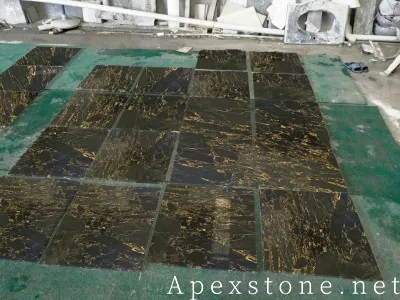
black Marble Splitface board wall fireplace
Sep 09, 2025
What Happens During Installation
You are correct. Out-of-plumb, unlevel, and wavy walls create significant issues for splitface stone, which is a mosaic net of irregular, chiseled stones.

The primary problems are:
1. Severe Lipping and Shadow Lines: Because each splitface piece has a random thickness, an uneven wall will exaggerate this. Some stones will protrude far out, while others will be recessed, creating deep, dark shadows and an extremely uneven surface that looks chaotic and unprofessional.
2. Difficulty Maintaining a Consistent Plane: The entire wall should look like a single, cohesive stone surface. On a wavy wall, this is impossible. The installation will follow the wall's imperfections, making them more obvious rather than hiding them.

3. Awkward Gaps at Corners and Edges: Where the stone field meets the ceiling, adjacent walls, or the fireplace mantle, the inconsistent plane will create large, tapered, and difficult-to-finish gaps.
4. Structural Failure Risk: If the wall has too much variation, the thinset mortar bed will also be of inconsistent thickness. Thick areas are more prone to sagging before the mortar cures, and very thin areas may not have sufficient adhesion, leading to stones loosening over time.
What We Need To Do When Installing
The solution is 100% in the preparation. The goal is to create a perfect substrate before a single stone is applied.
1. The Non-Negotiable First Step: Building a True Flat Plane
• Furring Out the Wall: This is the most critical step. Installers must create a new, perfectly plumb and flat surface over the existing uneven wall.
• How it's done: This typically involves installing a framework of metal studs or treated wood battens. Using shims, each stud is meticulously set to be perfectly plumb and aligned with all the others. A cement backer board (e.g., Hardiebacker, Durock) is then screwed to this leveled framework.
• Verification: Use a long (6-8 foot) straightedge and a level to check the new surface across its entire area. There should be no gaps or rocking.

2. Dry Layout and Planning
• Test Layout: Before mixing any mortar, dry-lay sections of the splitface mosaic on the floor. This helps you understand the pattern, blend pieces from different boxes for color consistency, and identify any undesirable pieces.
• Plan the Edges: Decide how you will handle the perimeter. Will you use a trim piece (like a metal Schluter strip) for a clean edge, or will the stone run to the edge and be caulked?

3. Installation Technique for Splitface
• Use the Right Mortar: A high-quality, non-sag, polymer-modified (fortified) thinset mortar is mandatory. This type of mortar is designed for vertical applications and heavy stone, preventing it from sliding down the wall.
• Butter the Back: "Back-butter" each individual sheet by applying a consistent layer of mortar to the back of the netting. This ensures every stone has maximum adhesion and helps push mortar into the voids.
• Press and Check: As you press each sheet onto the wall, frequently use a wooden beating block (a block of wood) and a rubber mallet to gently tap the entire surface. This ensures all stones are embedded in the mortar at a consistent depth and helps create that flat, unified plane.
• Constantly Check for Flatness: Use your straightedge across the surface of the stones as you work to ensure you are maintaining a flat plane and not creating a "belly" or "wave" in the installation.

4. Grouting and Finishing
• Grout Selection: Use a non-sanded grout for narrow joints or a sanded grout for wider joints. The color is crucial; often, a dark grey or charcoal is used to complement the Portoro's black background and add depth to the texture.
• Grouting Technique: Force the grout deep into the joints with a grout float, carefully working across the textured surface to avoid scratching the stone. A careful and thorough cleanup with sponges is essential.


